
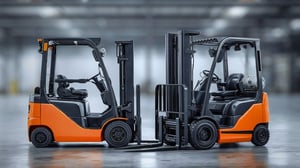
When procurement teams or rental fleet managers compare forklifts, the conversation often starts—and ends—with the purchase price. And that’s understandable: an internal combustion truck can look cheaper on day one. But in material handling, where assets run thousands of hours in demanding conditions, the real question is how much each truck costs to power, maintain, and keep compliant over its lifetime. Once you follow the money beyond the sticker, a pattern emerges. Fuel invoices accumulate faster than expected. Preventive maintenance turns into reactive repairs. Ventilation and indoor air quality measures add overhead. Then regulations and ESG commitments tighten, pushing combustion assets into costlier territory.
Meanwhile, modern electric platforms—especially lithium‑ion—deliver lower energy costs per operating hour, fewer maintenance interventions, and simpler compliance, all while improving indoor environments for operators. That’s the story we’ll unpack: a qualitative, detail‑rich comparison of IC versus electric forklifts, with special attention to the hidden costs that slip past “cheap to buy” narratives and the policy signals that make electrification an increasingly pragmatic choice for mainstream fleets.
What “IC” really means in everyday operations

In practice, an IC forklift is a machine built around hydrocarbon fuels—diesel, LPG, gasoline, or CNG—chosen historically for outdoor work, rough yards, and heavy pallets where quick refueling and high torque matter. That heritage still counts. Yet many fleets today run mixed duty cycles: indoor pick‑pack, cross‑docking at night, cold storage shifts, and seasonal peaks. In those environments, the combustion advantages narrow while the liabilities grow, with fuel price volatility, exhaust management, and service windows that dig into uptime.
Electric trucks have matured into serious, multi‑shift tools with consistent torque delivery, fast opportunity charging, and zero tailpipe emissions, which reduces the costs of operating in enclosed spaces. The market data reflects this shift, with electric models now favored for lower operating expenses and cleaner indoor air, particularly in warehousing and food logistics.
The “IC is cheaper” assumption breaks down
The notion that “IC is cheaper” fades once you model the entire operating life of a forklift in hours, not months: on energy alone, IC trucks routinely spend more per hour than electrics—diesel and gasoline units often land around $3.25–$5.00/hour, with propane slightly lower at $3.00–$4.00/hour, while modern electric forklifts typically consume electricity in the $1.50–$2.50/hour band (and roughly ~2.1 kWh per operating hour in current warehouse duty cycles), a gap that compounds rapidly across multi‑shift fleets and seasons.
Then add maintenance intensity: heavy‑duty diesel trucks commonly post $2,000–$3,500+ per year in scheduled upkeep, and $150–$200/hour shop rates turn “small” repairs into material line items, because combustion platforms carry a web of dependencies—oil changes every ~250 hours with filters, recurring air and fuel filtration to protect intake and injectors, and ignition parts like spark plugs at 1,000–1,500 hours on gasoline/LPG units, each visit dragging in labor, parts logistics, and downtime that never appears on the purchase invoice. Electric forklifts strip away entire categories of work by design—no engine oil, no fuel circuit, no spark ignition—and field comparisons consistently show 40% fewer maintenance interruptions and meaningfully lower unplanned downtime thanks to simplified drivetrains (~70% fewer moving parts).
In addition to that, lithium‑ion fast charging that fits the rhythm of the shift rather than forcing it, with 1–2 hour full charges and high‑throughput “top‑offs” during breaks, so assets spend more time where value is created and less time queued for service or refueling. Even in shared systems such as hydraulics, electrics tend to run cleaner, with less thermal and particulate contamination from nearby combustion components, extending fluid intervals and reducing intervention frequency. By contrast, IC fleets quietly accumulate costs in areas like tire wear (vibration, torque spikes, heat) and compliance overhead tied to emissions after‑treatment and ventilation for indoor work, all of which add friction to planned maintenance programs and inflate the administrative burden of keeping trucks available.
When the numbers are rolled up over a typical five‑year horizon—energy spend, consumables, labor, downtime, and compliance—the initial sticker advantage of IC is eroded by recurring, systemic costs, whereas lithium‑ion platforms replace complexity with predictable service intervals, higher uptime, and smoother utilization, producing a more resilient, lower‑variance cost profile across the life of the asset—and, in many jurisdictions, positioning fleets ahead of tightening emissions rules that increasingly penalize combustion equipment indoors and in nonroad applications. For fleet managers and decision‑makers, the takeaway is clear: the real savings of electrification are not found in a single line item, but in the cumulative impact of eliminating entire maintenance categories. Over years of operation and thousands of hours, those hidden costs are no longer hidden, and electric forklifts emerge not just as a cleaner option, but as the more economically rational one.
Beyond cost savings: the strategic advantages of lithium‑ion forklifts

Up to this point, the comparison between IC and electric forklifts has focused primarily on cost visibility—what fleets pay in fuel, maintenance, and downtime. Lithium‑ion forklifts, however, deliver value well beyond pure economics. Their advantages touch sustainability, operational performance, safety, and asset longevity in ways that are increasingly relevant to modern industrial operations.
One of the most immediate and measurable differences is emissions. Lithium‑ion forklifts operate with zero tailpipe emissions, fundamentally changing the environmental footprint of material handling activities. Unlike IC forklifts, which generate exhaust gases and particulate matter as an inherent consequence of combustion, electric trucks shift emissions—if any—upstream to the energy mix. For indoor applications, this distinction is critical. Eliminating exhaust improves air quality and removes the need for additional ventilation systems, while also protecting operators from prolonged exposure to pollutants. At a broader level, zero‑emission operation supports corporate sustainability commitments and prepares fleets for tightening environmental regulations, which are already reshaping equipment choices in many regions.
Energy efficiency further strengthens the economic case. Lithium‑ion forklifts convert a significantly higher proportion of input energy into usable work compared to combustion engines, where heat losses and idle consumption erode efficiency. In practical terms, this means electric forklifts can operate longer on a given amount of energy and deliver more consistent performance per kilowatt-hour. Over time, this efficiency translates into lower and more predictable operating costs, particularly valuable in high‑utilization, multi‑shift environments where energy consumption dominates the total cost of ownership.
Maintenance reductions amplify these savings. As discussed earlier, lithium‑ion forklifts eliminate a wide range of service activities tied to engines, fuel systems, and exhaust after‑treatment. What’s equally important is how that simplification affects productivity. Fewer maintenance events mean fewer service interruptions, fewer scheduling conflicts, and greater fleet availability. Reliability becomes less dependent on preventive maintenance discipline and more inherent to the design of the machine itself. The result is a material increase in usable uptime, which often matters more than marginal differences in purchase price.
Performance characteristics also favor lithium‑ion technology. Electric drivetrains deliver instant torque from standstill, ensuring smooth acceleration and consistent power output throughout the entire discharge cycle. Unlike IC forklifts, whose performance degrades as fuel levels drop, electric forklifts maintain full power until the battery reaches its lower state of charge limit. In fast‑paced warehouses, this consistency matters. Operators can move loads with precision and confidence, cycle after cycle, without compensating for declining engine response. Improved maneuverability and responsive control contribute directly to higher throughput and more predictable task timing.
Safety and operator comfort benefit from the same characteristics. Electric forklifts are inherently quieter and generate less vibration than combustion models, improving the working environment, especially during extended shifts. Lower noise levels reduce fatigue and enhance situational awareness, both of which are critical for accident prevention in busy facilities. At the same time, removing liquid fuels from the equation eliminates risks associated with fuel storage, spills, and fire hazards. Cleaner air, fewer handling risks, and lower noise converge to create workplaces that are not only safer, but more attractive for operators, a growing consideration in tight labor markets.
Durability and lifespan round out the picture. Lithium‑ion batteries are engineered for high cycle life and can withstand frequent partial charging without the degradation issues that affect traditional lead‑acid systems. Advanced battery management systems continuously regulate temperature, voltage, and charge rates, protecting the battery from abuse and extending its usable life. From an ownership perspective, this stability reduces both replacement frequency and performance uncertainty at later stages of the forklift’s life. Combined with fewer mechanical stress points across the vehicle, lithium‑ion forklifts tend to retain operational capability and residual value more effectively than IC alternatives.
Conclusion: From cost comparison to industrial strategy
The evidence points in one direction, but the strategic question is broader than “IC vs. electric.” It’s about how your organization builds resilience, competitiveness, and compliance into its material‑handling backbone. Lithium‑ion forklifts change more than the operating cost line, they simplify systems, compress downtime, and de‑risk regulatory exposure. Strategically, that enables a different operating model: one where fleet availability is more predictable, energy planning is part of an integrated facilities strategy, and maintenance becomes a managed exception rather than a constant drumbeat.
For procurement and operations leaders, the winning play is to treat electrification as a platform decision, not a unit swap. That means mapping charging infrastructure to workflow (opportunity charging near pick‑pack lanes, fast charging at staging areas), aligning PM schedules with production windows, and using battery health telemetry to inform replacement cycles and residual value. It means re‑writing sourcing policies to privilege lifetime economics over sticker price, and measuring ROI in terms of throughput stability, operator safety, and regulatory headroom. Finally, it means building a change roadmap with finance and EHS at the table: capture incentives where available, bake ESG targets into fleet KPIs, and formalize the governance that keeps energy, maintenance, and compliance moving in lockstep.
In short, electrification has become a strategic lever to modernize industrial operations. Organizations that act now will lock in lower total cost of ownership, reduce risk, and create cleaner, safer, more reliable facilities. Those that wait will find the hidden costs of IC aren’t just line items; they’re structural liabilities that slow the business.
Author: Francesco Patroncini