

1. Executive summary
The off‑highway machinery ecosystem—construction, agriculture, mining, and material handling—is approaching a critical pivot. Global component sales like hydraulics, gears, electronics, and electric powertrains are projected to reach ~$50 billion by 2030 (1), yet technology adoption remains slower than in on‑road markets. Three structural factors explain the lag:
-
Sparse, fragmented policy drivers. Unlike automotive, few targeted regulations incentivize low‑emission, high‑safety, or automated off‑highway machines across geographies. Adoption of higher‑value systems, like advanced electronics, therefore, concentrates in narrow niches, limiting scale effects.
- OEM conservatism combined with value‑sensitive end users. OEMs typically invest when customers prove willingness to pay. In construction, cost sensitivity is high; lower‑value models often grow volumes faster than high‑value configurations, and OEM pricing pressure constrains suppliers’ ability to scale new technologies. Competitive pressure from Chinese OEMs, however, is pushing incumbents to differentiate with electrification and advanced features.
- High‑mix, low‑volume fragmentation: Off‑highway spans dozens of machine families and duty cycles; some variants sell only a handful of units annually. The result is complex integration, limited reuse, and slower learning curves for new tech. Emerging “electrify‑the‑jobsite” concepts—modular power, energy hubs, and platform approaches—aim to reduce these barriers.
Despite these headwinds, two pathways can unlock outsized value. The first is the electrification of compact and mid‑range equipment, where duty cycles include frequent pauses and partial loads. Here, PMAC motors deliver high torque density and instant response; electric drivelines consume near‑zero energy at idle, and OEM tools report practical runtimes (e.g., ~4 h at light duty from a 20-kWh pack) with ~50‑minute fast‑charge to 80%—compatible with normal shift routines. The second is a software‑driven and modular deployment, borrowing from automotive SDV concepts and “whole‑site” electrification. By shifting customization into software and standardizing charging/power interfaces, suppliers and OEMs can scale features across platforms while controlling cost and complexity. This whitepaper contributes practical evidence by comparing energy consumption and productivity for a representative compact electric excavator versus a diesel counterpart under light and medium urban/utility duty cycles. The findings:
-
Electric delivers lower operational energy (~5.0–6.7 kWh/h vs diesel ~2.2–3.4 L/h ≈ 22–34 kWh/h input), driven by drivetrain efficiency and zero‑idle behavior.
-
Productivity is equivalent, and it’s supported by instant torque, steadier hydraulics, and significantly lower NVH (Noise, Vibration and Harshness).
-
Shift planning is simple with a single fast‑charge window.
-
Diesel remains the right tool for remote, continuous high‑load tasks until site power becomes commonplace.
The remainder of the report quantifies these results (Ch. 2), examines operator and cycle‑execution effects (Ch. 3), and translates them into day‑plan guidance and deployment checklists (Ch. 4). These findings complement the framework established in our earlier analysis, “Understanding the Total Cost of Ownership for Electric Vehicles”, by linking performance‑based outcomes directly to planning and cost‑evaluation practices.
2. Energy consumption
Understanding energy consumption across light‑ and medium‑duty duty cycles is foundational to compare electrified and diesel compact excavators. While both machine types deliver broadly comparable digging performance, their energy profiles differ dramatically, not only in raw consumption but also in how energy is used during different work phases. This chapter quantifies those differences using representative data from a 2.6–2.8 t class electric compact excavator and its diesel counterpart.
The reference electric excavator operates with a 20-kWh lithium‑ion battery at 48 V, driving a permanent‑magnet traction motor rated at 18 kW peak and 14.8 kW continuous. Under typical use, the machine provides an indicative runtime of up to 4 hours (2), depending on workload and hydraulic demand. But runtime varies significantly by duty cycle. The official runtime/charging calculator shows that under moderate workloads, the machine achieves several hours of continuous operation—while in mixed cycles, pauses and idling extend usable runtime further because electric systems consume near‑zero energy when not actively working (3). This behavior sharply contrasts with diesel machinery, where idling continues to burn fuel regardless of workload. In many jobsite studies, compact diesel excavators idle for 20–40% of the shift (3); this directly increases fuel consumption without contributing to productive work.
To derive a practical kWh per operating hour, we divide usable energy (20 kWh) by typical runtimes observed in light/medium scenarios:
-
Light duty (fine trenching, frequent pauses):
Runtime ~4.0 h → ~5.0 kWh/h
-
Medium duty (continuous trenching in standard soil):
Runtime ~3.0–3.5 h → 6–6.7 kWh/h
This range aligns with the machine’s continuous power draw and reflects the efficiency of permanent magnet motors, which maintain high conversion efficiency across varying loads.
Now let’s look at the energy profile of a comparable diesel machine. Because compact excavators in this class rarely publish OEM fuel consumption figures, industry validated ranges must be used. Multiple independent datasets confirm that mini excavators in the 1–10-ton category typically consume 1–4 L/h, depending on load and digging intensity. We can then make an estimate of consumption for a machine with ~23 hp (comparable to our reference diesel excavator):
-
Low load: ~2.2 L/h
-
Medium load: ~3.4 L/h
-
High load: ~4.5 L/h
For the purposes of this whitepaper—focused on light/medium duty—the relevant ranges are 2.2–3.4 L/h. Idling remains a large contributor to total fuel use. Diesel engines consume fuel continuously at idle, often 0.8–1.2 L/h, meaning even modest idle percentages inflate total fuel burn significantly. This effect is absent in electric operation. To evaluate energy consumption on a common basis, we compare the raw hourly consumption:
Electric (Light/Medium)
-
Light duty: ~5.0 kWh/h
-
Medium duty: ~6–6.7 kWh/h
(Real world value depends on operator behavior, hydraulic load, and idling share.)
Diesel (Light/Medium)
-
Light duty / low load: ~2.2 L/h
-
Medium duty: ~3.4 L/h
The more meaningful comparison for operators is operational energy (4), that reflects how much energy is consumed to deliver equivalent digging performance under similar workloads. In operational terms:
-
Electric machines consume less total energy per productive hour because their drivetrain efficiency is significantly higher and idling draws no power.
-
Diesel machines consume more energy during non-productive time (idling, short pauses, boom repositioning), which accumulates disproportionately in light and medium duties.
Runtime tools show that even on a full battery, electric machines deliver 4–5 hours of usable operation in realistic conditions with no worries about fuel burned at idle. A diesel machine applying the same workload pattern—where 20–40% of the time may be spent idling—would see total consumption rise above the theoretical 2.2–3.4 L/h values and often into 3–4 L/h effective averages.
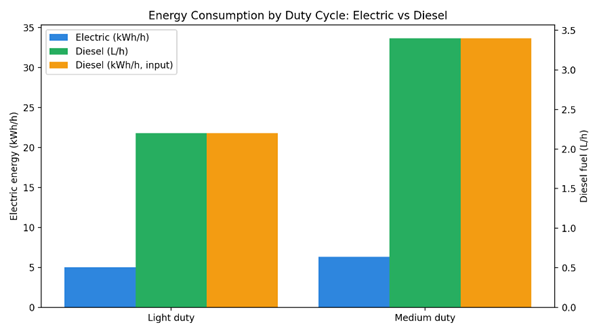
In light/medium scenarios, electric averages ~5.0–6.7 kWh/h; diesel consumes ~2.2–3.4 L/h—equivalent to ~22–34 kWh/h input energy. This comparison highlights several key conclusions:
- Electric excavators are inherently more energy efficient, using only the energy required for actual hydraulic or traction work.
- Diesel excavators suffer from idle penalties that inflate consumption, particularly in light and medium duty cycles where task interruptions are frequent.
- In real jobsite conditions, the electric machine’s effective energy consumption per productive hour is lower, even when absolute energy per hour seems similar.
-
These differences scale directly with runtime: a 20-kWh pack delivering 3–4 hours of real work indicates high efficiency relative to the diesel machine’s chemical energy input.
3. Productivity and operator factors
Productivity in compact excavator applications is governed by how effectively the machine converts energy into hydraulic work, how consistently that work can be performed, and how the operator experiences and controls the machine over a full shift. In light‑ and medium‑duty construction tasks, the differences between electric and diesel platforms become increasingly visible.
This section evaluates key productivity determinants: hydraulic performance, torque delivery, cycle execution, and operator experience, comparing an electric compact excavator with its diesel equivalent in the same 2.6–2.8 t class.
3.1 Powertrain characteristics
Electric compact excavators use permanent magnet motors that deliver maximum torque instantly from zero RPM. This gives them immediate response to operator commands, without waiting for the engine to reach its torque band—a core performance difference from diesel machines. Electric drivetrains also maintain high efficiency across varying loads, enabling smoother implement transitions and quicker reactions during trenching, leveling, and repositioning.
Diesel engines, by contrast, rely on combustion-driven torque curves and must increase RPM to reach peak torque. This creates transient lag that can extend cycle times, especially during fine repositioning or rapid switching between boom, arm, and slew movements. As widely noted in comparative equipment evaluations, these characteristics often make diesel machines feel less precise in light and medium-duty tasks.
As a result, in applications where responsiveness and control matter more than raw horsepower, electric excavators typically deliver more consistent cycle execution with less operator compensation.
3.2 Hydraulic performance
Hydraulic performance is a core productivity determinant for any excavator. The reference electric compact excavator features a main pump flow of approximately 58 L/min, along with breakout and tear‑out forces (≈22.3 kN breakout; ≈17–18 kN arm forces depending on configuration) that match or closely mirror the diesel equivalent. Industry comparisons confirm that electric compact excavators in this class maintain comparable hydraulic pressure and implement performance to their diesel counterparts. In some cases, the electric variant slightly exceeds the diesel version in continuous motor power or hydraulic consistency because electric motors maintain stable output regardless of RPM fluctuations.
For light‑ and medium‑duty tasks—including utility trenching, backfilling, grading, and site preparation—the result is functional parity in digging performance. Operators do not need to adjust their technique or expectations when switching between electric and diesel machines for these workloads.
3.3 Cycle consistency
Cycle consistency is another essential productivity metric, particularly in compact equipment that frequently performs short, repetitive cycles.
Electric machines benefit from:
- Immediate control response due to electric motor torque characteristics.
-
Reduced slew and implement vibration because the driveline lacks combustion related pulsations.
Lower vibration and noise contribute to improved operator precision, especially when working in confined or urban environments. The reference electric excavator produces significantly lower exterior and interior sound levels (LpA ~74 dB, LWA ~84 dB) (2) compared to typical diesel machines, which reduces cognitive load and fatigue over a workday.
The diesel comparator, while fully capable within this weight class, introduces more variability in cycle timing due to engine speed adjustments every time hydraulic demand changes, higher noise and vibration and hydraulics readiness. These effects are subtle but meaningful, particularly in repetitive medium duty cycles such as trenching in standard soil or material placement around utilities.
3.4 Work quality and productivity
Operator performance depends heavily on comfort, noise, smooth controls, and cognitive load. Industry evaluations consistently show that electric equipment produces far less noise and vibration than diesel, reducing fatigue and making long periods of arm and slew work easier. Lower noise also improves communication with ground crews, situational awareness on tight sites, and confidence during precision tasks—all of which enhance work quality, reduce rework, and shorten learning curves.
These findings align with productivity data. In light and medium duty cycles with frequent pauses, electric excavators benefit from near‑zero idle consumption and excellent low‑speed controllability, producing steadier cycle times, consistent output per unit of energy, and less operator fatigue over a shift. Diesel machines face unavoidable idle losses and higher operator workload, leading to more variable cycle times and slightly lower effective productivity. Both platforms offer adequate hydraulic capability in this weight class; the difference is how consistently that capability can be applied and how efficiently the energy behind it is used.
4. Implications for jobsite planning
Permanent magnet AC motors used in electric compact excavators provide several characteristics that directly impact jobsite productivity. This section outlines the key implications for jobsite planning, focusing on power delivery, efficiency, runtime strategy, and deployment considerations for light to medium duty construction work.
4.1 Torque density and power delivery
- Instant torque from zero RPM. PM motors deliver full torque immediately, eliminating engine rev up delays. This produces smoother implement transitions and reduces cycle variability in trenching, grading, and short repetitive tasks.
- High torque density. PM motors generate strong torque with less mass and volume than induction or diesel powertrains, improving responsiveness and reducing mechanical losses. Their low-speed torque holds up well under rugged, repetitive off highway duty cycles.
- Stable power across workload changes. Diesel torque and hydraulic responsiveness vary with RPM, while PM motors maintain consistent output across the full speed range. This supports predictable cycle performance and helps reduce operator dependent variability.
4.2 High conversion efficiency
Electric excavators consume almost no power when they aren’t actively working, which becomes a major advantage in light and medium duty cycles where frequent pauses, checks, and short repositioning movements are part of normal operation. Diesel machines, by contrast, continue burning fuel whenever the engine is running—typically 0.8–1.2 L/h at idle (2)—adding substantially to total shift consumption even when no productive work is being performed. The efficiency gap widens further when the machines are under load. PMAC electric motors routinely operate at 90–95% efficiency across a wide range of speeds and workloads, while diesel engines generally remain limited to 30–40% efficiency even under ideal load conditions, and perform noticeably worse when operating outside their narrow optimal RPM band.
This difference is reflected in the scale of energy each system draws: a diesel compact excavator in medium‑duty conditions effectively consumes ~22–34 kWh/h of chemical energy, whereas the electric counterpart uses only ~5–6.7 kWh/h of electrical energy to deliver comparable work. The contrast stems not only from the inherent efficiency of electric drivetrains, but also from the structural idle losses built into combustion engines. For contractors, the result is more predictable and often lower operating energy costs.
4.3 Runtime planning and charging strategy
Runtime patterns of electric compact excavators in light‑/medium‑duty cycles are now well characterized. A 20-kWh electric compact excavator provides ~4 hours of operation under light duty and 3–3.5 hours under medium duty. However, jobsites rarely involve continuous digging. Runtime calculators show that in mixed-use scenarios with idling and short interruptions, electric machines may complete a typical shift without mid‑day charging, depending on utilization profile. Fast‑charging capability further increases planning flexibility. Off‑board charging can bring the battery back to 80 percent in about fifty minutes, making it practical to top up during lunch or while transitioning between tasks. This creates a predictable daily rhythm: several hours of productive work in the morning, a brief fast‑charge window at midday, and another solid block of work in the afternoon—without disrupting crew coordination or workflow.
Successful deployment depends on having the right charging infrastructure available and integrating charging moments naturally into the project flow. Access to a 400 VAC power source—whether from the grid, a generator, or mobile energy storage—ensures fast charging is consistently achievable. Equally important is aligning charging windows with built‑in jobsite pauses and managing battery use across multiple machines so fleets remain balanced throughout the day. When these elements are planned together, electric compact excavators fit comfortably into typical construction schedules and often simplify the day rather than complicate it.
4.4 Deployment considerations
Electric compact excavators show strong advantages in:
-
Urban and residential projects requiring low noise (electric ~74 dB operator level vs significantly higher levels for diesel).
-
Indoor or enclosed space work (zero tailpipe emissions)
-
Repetitive light/medium cycles
-
Fine handling tasks
-
Regulated markets or ESG driven projects
While Diesel remains strategic in:
-
Remote jobsites without reliable power for charging
-
High duty cycles requiring sustained continuous operation beyond 4–6 hours without breaks
-
Cold weather regions where battery thermal management and cabin heating impose additional draw
In these cases, hybrid approaches (on site mobile energy storage + electric machinery) can serve as transition solutions. In general, contractors should match machine selection to jobsite profile, but for the majority of municipal, landscaping, utility, and compact urban projects, electrification offers tangible productivity and efficiency rewards.
5. Conclusion
Electrification in construction is progressing, though adoption remains limited by policy gaps, conservative OEM roadmaps, low‑volume platforms, and higher initial costs. In light and medium duty applications, compact electric excavators already show operational strengths, while Diesel remains advantageous on remote sites without charging access and in continuous high‑load operations where rapid refueling and uninterrupted runtime are critical.
The purpose of this whitepaper is to present duty‑cycle‑based data and practical planning scenarios to clarify where electric machines provide measurable benefits and how they can be deployed with minimal workflow impact. It also identifies current adoption barriers—capital cost, charging infrastructure, and mixed‑fleet integration—to guide OEM and supplier efforts toward the most impactful solutions. Electrification is application‑dependent, but when matched to suitable duty cycles and supported by appropriate charging strategy, electric compact excavators already function as productive, energy‑efficient assets that can be incorporated into standard jobsite planning.
References
1. Interact Analyst. (2025). $50bn off-highway component market stuck in the slow lane. https://interactanalysis.com/insight/off-highway-component-market/
2. MDPI (2025). CO2e Life-Cycle Assessment: Twin Comparison of Battery–Electric and Diesel Heavy-Duty Tractor Units with Real-World Data. https://www.mdpi.com/2673-7590/5/1/12
3. Volvo (2021). Electric Construction Equipment vs. Diesel Performance comparisons https://www.volvoce.com/united-states/en-us/resources/blog/2021/electric-construction-equipment-vs-diesel-performance-comparisons/
4. UCI, Institute of Transportation Studies (2025). Electrification of Off-Road Construction Vehicles: A Comparative Economic Analysis of Electric and Diesel Machinery. https://its.uci.edu/research_products/conference-paper-electrification-of-off-road-construction-vehicles-a-comparative-economic-analysis-of-electric-and-diesel-machinery/
5. Fluid Power Journal. (2025). Electrification and hybrid trends in heavy construction equipment. Retrieved from https://fluidpowerjournal.com
6. MDPI (2023). Toward Zero Emission Construction. Comparative life‑cycle impact assessment of diesel, hybrid, and electric excavators. https://www.mdpi.com/1996-1073/16/16/6025
7. GEP. (2025). The evolution of electric and hybrid construction equipment. https://www.gep.com/blog/mind/evolution-of-electric-hybrid-construction-equipment
Author: Francesco Patroncini